
peckford42.wordpress.com/2026/01/25/carney-trump-terry-burton-says/
CRACKS IN THE COVID WALL OF SILENCE
MARK OSHINSKIEJAN 15 READ IN APP My friend, Jim, is among the nicest males I’ve met. Though his life has challenges, he bears these with …
CRACKS IN THE COVID WALL OF SILENCE
The Pandemic Revealed the Most Cowardly Society of All Time
BY FILIPE RAFAELI DECEMBER 10, 2025 HISTORY, MEDIA, PHARMA 21 MINUTE READ SHARE | PRINT | EMAIL If you think that in this article I’m going to …
The Pandemic Revealed the Most Cowardly Society of All Time
Europe’s Race to Net-Zero – and Total Self-Destruction?
by Drieu GodefridiNovember 7, 2025 at 5:00 am In 1992, global carbon dioxide (CO₂) emissions stood at 22.3 billion metric tons. By 2024, they had …
Europe’s Race to Net-Zero – and Total Self-Destruction?
Marc Miller and Pandora’s Box : When Censorship Turns On Faith
Author: Terry Burton, Retired Canadian Businessman
Marc Miller and Pandora’s Box : When Censorship Turns On Faith
A Magnificent Essay—By Leighton Grey, Alberta Lawyer —Christian Focused Leadership
Master & Servant How Ethical Leadership Can Save Canada Leighton B.U. Grey – October 27, 2025 Canada should be one of the world’s best countries to …
A Magnificent Essay—By Leighton Grey, Alberta Lawyer —Christian Focused Leadership
BC Electoral Reform Committee: 93% support for proportional representation in public consultation – Fair Vote Canada
93% of those who participated in the public consultation of the BC Electoral Reform Committee with an opinion on the voting system recommended proportional representation.
— Read on www.fairvote.ca/06/10/2025/bc-electoral-reform-committee-93-support-for-proportional-representation-in-public-consultation/
John Robson: How ‘Rule of the Expert’ Is Displacing Genuine Self-Government in Canada | The Epoch Times
John Robson: How ‘Rule of the Expert’ Is Displacing Genuine Self-Government in Canada | The Epoch Times
— Read on www.theepochtimes.com/opinion/john-robson-how-rule-of-the-expert-is-displacing-genuine-self-government-in-canada-5905815
The Magic of the Washboard
The Magic of the Washboard
https://www.theepochtimes.com/opinion/the-magic-of-the-washboard-5905654
8/25/2025
Commentary
A tragedy of the digital age is how we’ve lost curiosity for how things work. No more taking apart a car and putting it back together again, as my brother and I did with a 1963 Volkswagen Beetle. No more fixing the transistor radio. No more homemade wiring. No more fidgeting with things.
We just buy and consume and throw away and buy more things. We spend $1,200 on a smartphone that we know for sure will be replaced in 3 years. Closets are packed with electronics and chords that we know for sure that we will never use. A refrigerator breaks and we have no clue what to do.
Meanwhile, when I encounter even the most simple things and see how they work, or at least try to, I find myself mystified.
Sometime in the last few years, I got so frustrated with washing machines—they have one job and are not doing it—that I started doing it myself in the tub. That set me on an adventure of discovering the best detergents, temperatures, soaking time, bluing, pre-treatments, and so on, all in an effort to discover precisely how clothing gets clean.
Somehow we are several generations deep in which people have absolutely no idea how clothes get clean. We stick them in a box and take them out and put them in another box. We are so unthinking about this, and so confident in our machines, we happen not to notice that our clothes are not getting clean.
Meanwhile, the blasting hot dryer is a disaster for clothing. The “lint” in the catcher is your clothing falling apart, so that you will buy more.
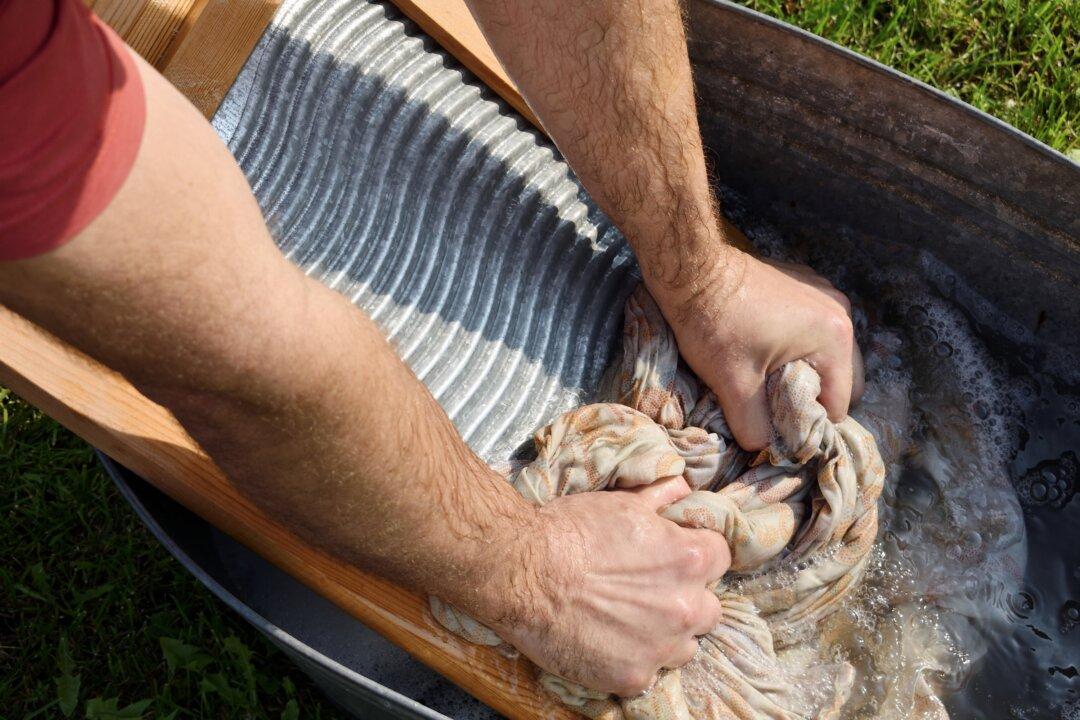
In the course of figuring out laundry from the bottom up, I got frustrated with rubbing clothing against other clothing and thought there must be a better way. Then I remembered: the washboard. Not the musical instrument; the actual tool for washing clothing.
I bought a cheap one.
I’m telling you, the washboard is pure magic. You grab the fabric and rub it on there. The stains and dirt disappear without wearing down the fabric. Soaking is essential but not the path of final cleanliness. That requires agitation. No “agitator” in the machine can compare to the precision and thoroughness of the washboard.
Human hands with the human mind plus mental focus: there is no machine that has ever managed to improve on that. Despite all the promises, conveniences, and habits of consumption for many generations, the best way is still the old way.
Who invented this great thing? And why is it so damn effective? Honestly, I find this tool thrilling in a way that the iPhone is not.
It turns out that the history of the washboard is fairly modern, tracing to the late 18th century and early 19th century, with American ingenuity at the heart of it. It seems simple. You have a frame of wood and a metal grate with a corrugated surface. It creates friction and agitation that dislodges dirt, grime, and stains from fabrics. No amount of rubbing clothes together substitutes.
Grok says: “Soap reduces the surface tension of water, allowing it to penetrate fabric fibers, while the washboard’s ridges help work the soapy water into the material, flushing out dirt.”
Maybe so. Maybe that’s the whole secret. I don’t know. I just know that they work extremely well.
These became really popular consumer items at the birth of the modern world, at a time when people started focusing on cleanliness and hygiene. They had money to buy things and clothing was becoming more democratized. All classes of people, not just the rich, started caring what they looked like and how they smelled.
The washboard was the key to brighter and cleaner clothes. Patents were being issued for new designs. They had nice handles and came in different sizes for different purposes.
Even now, I find myself fascinated by how well they work. I suppose I would not have thought so. It must have taken quite some experience and imagination to come up with the idea. It certainly is an improvement over a rock, which damages clothing, or a simple stick. It takes care of delicate fabrics and scrubs jeans really well too.
When the washing machine was invented, replicating the effectiveness of the washboard was the great challenge. It was never really overcome for one simple reason. The machine has to treat every piece of clothing, and every part of the clothing, the same way, with the same motion. This is pure waste, on the one hand, and also insufficient for some parts, on the other hand.
For example, when I do shirts, I obviously apply extra pressure and time on the cuffs and collars, while the major part of the shirt gets only a quick treatment unless there is a stain. You cannot do this in a machine. This is why we now pre-treat clothing but even that is not a worthy substitute for the action of a washboard.
This is a huge problem. A machine is not intelligent like human hands. We can use our brains and brawn to apply extra attention based on visuals. A machine programmed to regard every part of every fabric the same cannot do this.
The biggest downside to the machine: It acculturated many generations to forget or never learn how clothes come to be clean. It’s amazing, people truly have no idea.
It’s not just this. It’s pretty much everything. Old 78 records had a physical operation. You could almost see the sound on the surface, and the needle scratching on there was just a marvel that enticed the imagination. Who even knows how streaming music works? We are surrounded by things that are utterly mysterious.
Maybe that is okay, and I don’t really want to go back in time, except and to the extent that our age has enabled us to lose curiosity. Our ancestors were different. They cared intensely about tools and their operations.
The first Smithsonian museum was devoted to the history of the industrial arts. Today we call that “technology” but back then they knew it was really art. And everyone was super curious about it all, how it came to be, how things work, while celebrating the inventors and achievers and the companies that brought tools to the masses of people.
Are we still curious? I’m not sure. That old museum was closed years ago and all its content stuffed in some basement somewhere. Young kids are no longer taught about the history of American invention and are thus tempted to believe everything is now as it always has been, with no intellectual or physical effort required to make it happen.
Aside from typing and scrolling, there is not much a young generation does with its hands. Musical training is fading and shop classes in high school are rare. There is some effort these days to bring back real apprenticeships in actual skills but there is a long way to go.
To be sure, it is a glorious thing how YouTube has boosted the do-it-yourself industry, and cheers to the huge hardware stores that encourage people to make things and improve their homes with painting, gardening, deck building, plumbing, and so much more.
We should all do this more in our lives, not simply because it is fun but because it keeps our imagination alive in times that seem to be conspiring to blunt and kill them. It also feels great to bear personal responsibility for how something works.
Is there really no way to escape digital armageddon in which no one pays attention to anything but the magic box in our pockets? Is there any hope for regaining control of our world from the titans who have stolen our time, brains, communities, and relationships?
Sometimes the best way to start is with something seemingly simple. Like the washboard.
John Carpay: The Glaring Double Standard in the Prosecution of Lich and Barber | The Epoch Times
John Carpay: The Glaring Double Standard in the Prosecution of Lich and Barber | The Epoch Times
— Read on www.theepochtimes.com/opinion/john-carpay-the-glaring-double-standard-in-the-prosecution-of-lich-and-barber-5892032
 albertruel