
The Power of a Decision – The Blind Canadian, Volume 2, July 2005 – CFB
— Read on www.cfb.ca/the-blind-canadian-volume-2-july-2005
Category Archives: blindness
Many People Fully Vaccinated for COVID Are Now Going Blind – Global Research
Many People Fully Vaccinated for COVID Are Now Going Blind – Global Research
— Read on www.globalresearch.ca/many-people-fully-vaccinated-covid-now-going-blind/5778951
Ophthalmologists Now Ethically Obligated to Denounce COVID-19 Vaccines, as 20,000 New Eye Disorders Are Reported – Global Research
Ophthalmologists Now Ethically Obligated to Denounce COVID-19 Vaccines, as 20,000 New Eye Disorders Are Reported – Global Research
— Read on www.globalresearch.ca/ophthalmologists-ethically-obligated-denounce-covid-19-vaccines-20000-new-eye-disorders-reported/5744481
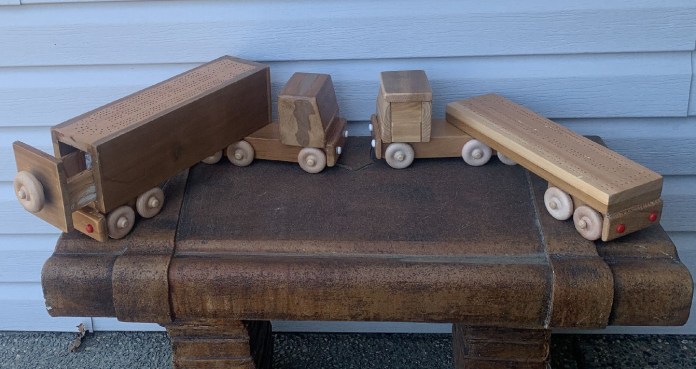
Semi Trailer Cribbage Trucks
Who wants to play crib instead of going to work?
Here are the two wooden trucks I have designed and built so far. They are both built out of solid western red cedar, except for the wheels and axle pins, which are purchased and made of hardwood. The box trailer has a drawer sliding out of the back of it for storage of cards and crib pegs, and the flatbed unit stores cards and pegs in the cab under the removable roof.
Both trucks are approximately 10 inches long and 4 1/2 inches wide, and the trailers are approximately 4 1/2 inches wide by 14 1/2 inches long.
“Who’s driving”, the current blindness narrative in Canada, a Triple Vision Podcast on AMI Audio
Triple Vision Podcast on AMI Audio
On Triple Vision, hosts David Best and Hanna Leavitt bring you the history of Canadians who are blind, deafblind, and partially sighted, one story at a time, illuminating the challenges of the past, present, and future.
Episode Summary
In this sixth episode of Triple Vision, we do something different. We invite six members of the community to talk about how they see the current blindness narrative in Canada.
What is wrong with the current narrative, and what should it be?
Who is controlling the current Canadian blindness story?
What should the future narrative sound like?
“The sad part is, we all look at the news as a news and information source, and it isn’t. It’s a drama. It’s a dramatic work and belongs in the arts. A lot of people go there for their information. Unfortunately if it bleeds, it leads. And when it comes to blindness, we don’t bleed so much, but my goodness the narrative is pity filled.”
Join us for this fascinating journey, exploring the dangers of the single narrative of the blindness story in Canada.
Triple Vision podcast called “Who’s driving”. 6 members of our Advisory committee talk about the current blindness narrative in Canada.
Find a link to the podcast below:
Blind Pride? – The New Hofstader.com
Epigram Some people say we’ve got a lot to stop us, Some say we have a lot of nerve, But I say we won’t quit pushing until we get what we deserve. We have been pitied and we have been scorned, They say, we shouldn’t have ever been born. But just as it takes two… Read more about Blind Pride?
— Read on www.chrishofstader.com/blind-pride/
VocalEye | Accessible Media Inc.
In this episode of Our Community, we experience theatre through VocalEye, a non-profit organization that is the first live description arts service for the blind in Canada.
— Read on www.ami.ca/category/our-community/media/vocaleye
Blind people don’t suffer from schizophrenia — and the reason could help us find a treatment
Blind people don’t suffer from schizophrenia — and the reason could help us find a treatment
Author: Mihai Andrei
Date Written: Oct 23, 2019 at 5:00 PM
Date Saved: 10/24/19, 9:10 PM
Source: https://www.zmescience.com/medicine/mind-and-brain/blind-schizophrenia-connection-14102019/
In February 2019, an intriguing study made the rounds. Researchers from the University of Western Australia found conclusive evidence that congenital blindness is protective against schizophrenia.
The unusual discovery offered new insights into the inner workings of schizophrenia, a condition which still has many unknowns, despite decades of research.
“This leads us to think there is a link that must be explored,” said Professor Vera Morgan from the UWA Neuropsychiatric Epidemiology Research Unit, lead author of the study.
Now, a new study sheds new light on that phenomenon and could help us better understand how schizophrenia works — as well as how we build a mental model of the world around us.
The mind’s eyes
The relationship between vision and psychosis is complex. While congenital visual loss appears to be protective against psychotic disorders, gradual visual loss can give rise to hallucinations or even psychotic episodes.
The age at which vision loss happens appears to be a crucial factor. The absence of vision at birth or very early in life appears to have a protective effect, whereas later-life visual loss appears to predispose one to the development of psychotic symptoms. This is particularly unusual as there are very few medical disorders that may be protective against psychosis (the already-notorious example is rheumatoid arthritis).
Researchers suspect that it’s not just the loss of sight that is at work here — it’s also the way the other senses and the brain are rearranged after vision loss. For instance, the brains of blind people adapt to sharpen the other senses, which they are also better at processing.
When something interferes with a person’s vision, it can also send all kinds of confusing signals to the brain. If a person with functioning eyesight is blinded, the auditory and tactile information that he or she receives will be chaotic, confusing, and potentially overwhelming. For a blind person, that just doesn’t happen, as the brain is used to processing this sort of information. Simply stated, their internal model of the world is simpler and more resilient to malfunctions.
“In simple terms, we argue that when people cannot see from birth, they rely more heavily on the context they extract from the other senses,” the researchers write. They also add that this can also explain the
relationship between later visual loss and other psychotic
symptoms, as well as the effects of visual deprivation and
hallucinogenic drugs on psychosis and schizophrenia.
While this is still somewhat speculative, this hypothesis would explain the effect. If this is true, then it would mean that congenitally blind people have overall lower psychosis susceptibility than the sighted population. There are also ways to test this, researchers say.
Congenitally blind individuals will show fMRI prediction error responses during causal learning, unlike people with psychosis whose prediction error is aberrant. In addition, they will experience reduced psychoactive effects from drugs such as ketamine
The study has been published in Schizophrenia Bulletin.
What Does �Blind� Have to Do with It? The Right to Parent from a Sighted Daughter’s Perspective
What Does �Blind� Have to Do with It? The Right to Parent from a Sighted Daughter’s Perspective
— Read on nfb.org/images/nfb/publications/bm/bm18/bm1808/bm180812.htm
 albertruel